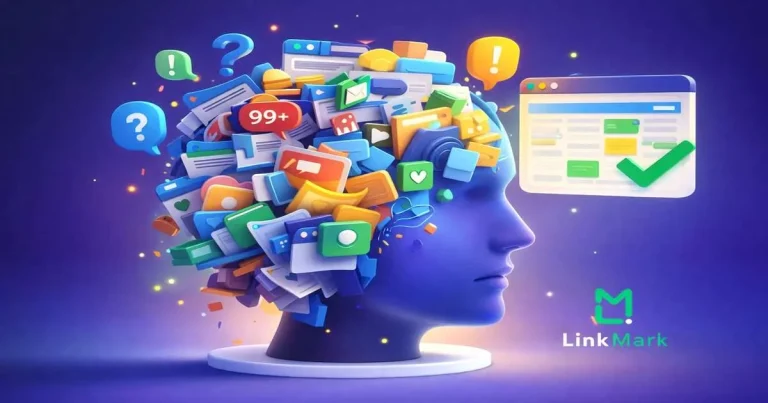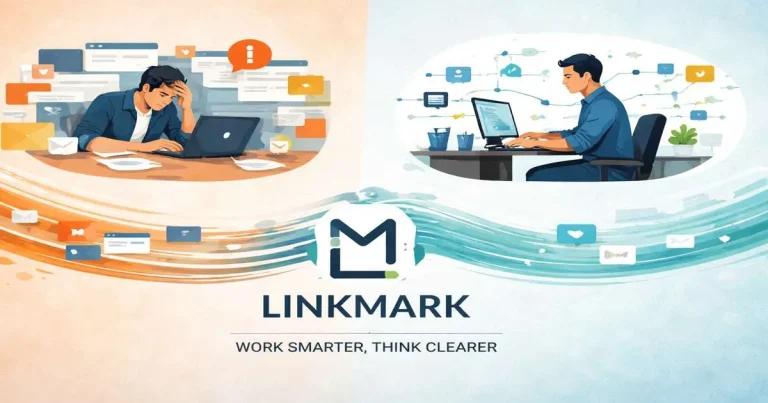

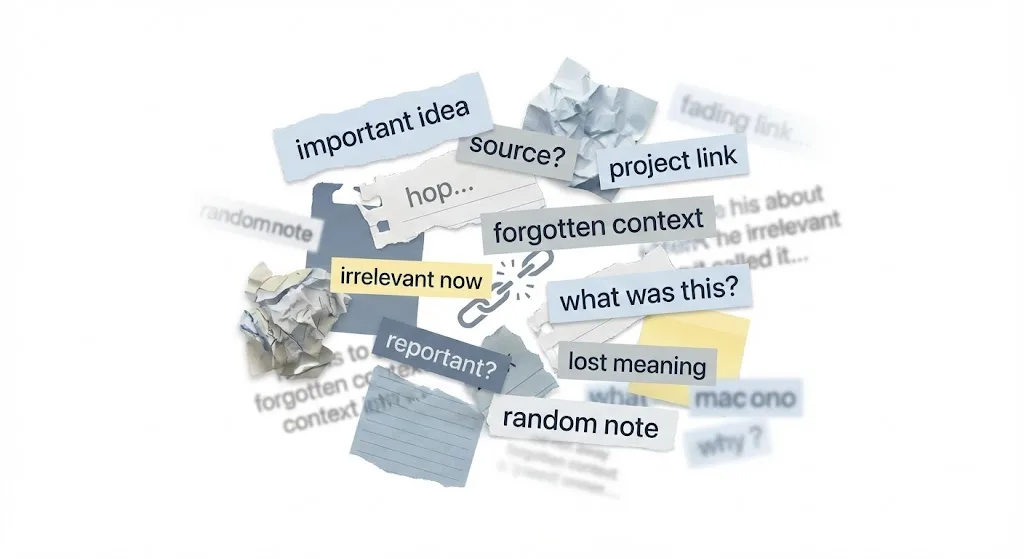

There is a strange moment that happens to almost everyone who works with information.
>You open a saved link—an article, a document, a page you once found valuable—and yet,
nothing clicks. You recognize the topic, maybe even the headline, but the meaning feels distant.
>You wonder why you saved it in the first place.
The information is still there. The words are still there.
What’s missing is the context—the invisible layer that once gave this information purpose.
When context disappears, information stops being useful and starts becoming noise.
The Silent Breakdown of Meaning
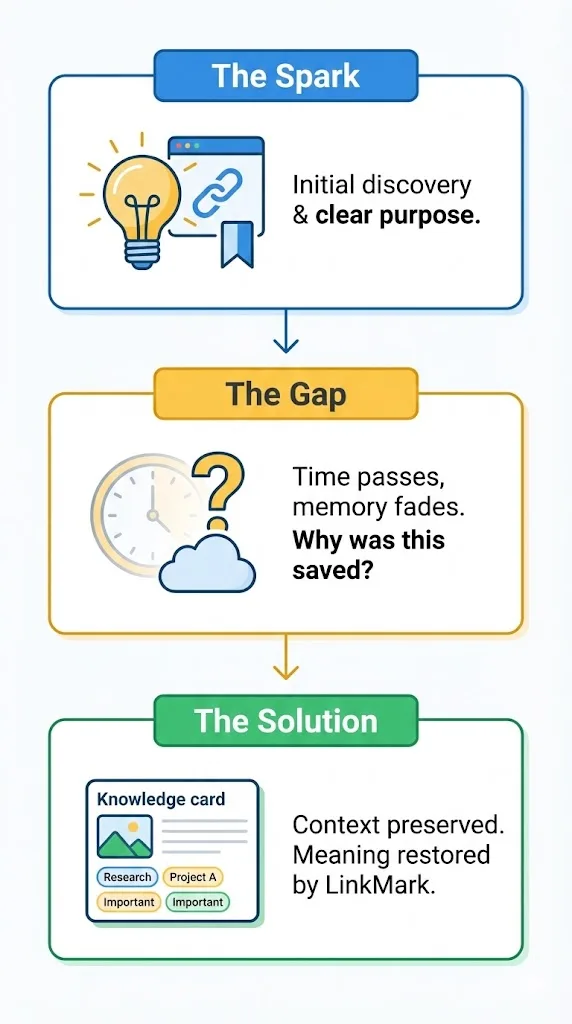
Information doesn’t lose its value all at once. It fades gradually.
At the moment you first encounter something, it is surrounded by intention:
a problem you were trying to solve, a question you were exploring, an idea you wanted to develop.
But when that information is saved without context, it becomes detached from its original meaning.
Days or weeks later, you return to it as a stranger.
The content hasn’t changed—but your relationship to it has.
This is how information quietly breaks down.
A Familiar Situation
You’re deep into a task and suddenly remember a resource that felt perfect when you first found it.
You saved it confidently. You trusted your future self to know what to do with it.
Now, staring at the link again, you feel uncertain.
Was this an example? A reference? Something to read later?
You scroll through it briefly, hoping the answer will surface.
Sometimes it does. Often, it doesn’t.
The information exists—but its purpose is gone.
Why Context Matters More Than Content
Context is what tells your brain how to use information.
It answers questions like:
- Why did this matter to me?
- What problem was I trying to solve?
- How does this connect to other things I saved?
Without these answers, information becomes isolated.
Even high-quality content loses its impact when it stands alone.
This is why saving more information doesn’t necessarily make us more informed.
In many cases, it does the opposite.
How the Internet Accelerates Context Loss
The internet encourages speed. We consume information rapidly and move on just as fast.
When we save something, we rarely pause to explain it to ourselves.
We assume the future will remember what the present understood.
But the future is busier, more distracted, and less patient.
As a result, saved information becomes disconnected fragments.
Each fragment makes sense on its own—but not within a larger system.
Traditional Tools and the Context Gap
Most tools are designed to store information, not preserve meaning.
Bookmarks save URLs. Notes apps save text. Read-later lists save pages.
What they don’t save is intent.
Folders and titles try to compensate, but they rely heavily on memory.
Search works only if you remember the right words.
Once memory fails, the system collapses.
The more information you collect, the wider the context gap becomes.
Traditional Tools and the Context Gap
The Emotional Cost of Lost Context
Lost context doesn’t just slow you down—it creates frustration.
>You feel disorganized. You doubt your own systems.
>You start questioning whether saving things is even worth it.
This often leads to defensive habits:
- Keeping too many tabs open
- Saving the same information multiple times
- Avoiding your saved links altogether
Over time, information overload turns into information avoidance.
Read more: LinkMark Across All Devices
Rethinking the Problem
It’s easy to believe the problem is discipline.
That we should organize better, write clearer titles, or clean up more often.
But the real issue is structural.
We are using tools that treat information as static,
while human understanding is dynamic.
Meaning changes. Context evolves.
Systems need to support that reality—not ignore it.
When Context Becomes Part of the System
This is where a shift begins.
Instead of asking users to remember everything,
the system itself starts carrying meaning.
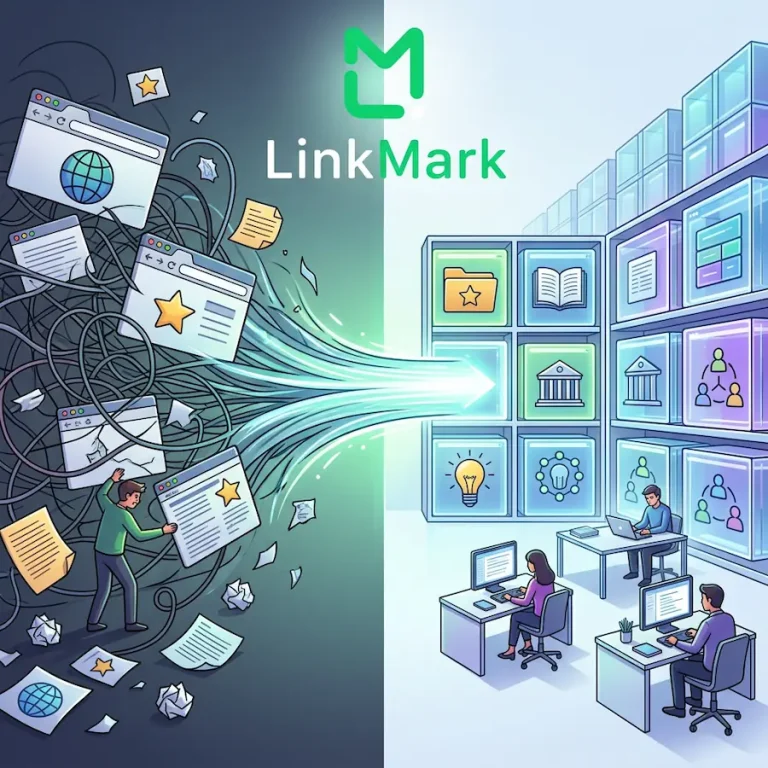
With LinkMark, saved information is not just stored—it is framed.
Each link exists within a structure that makes it recognizable later.
Context is not an afterthought; it is built into the experience.
This changes how information ages.
Instead of decaying into confusion, it remains accessible and relevant.
From Isolated Links to Connected Understanding
When context is preserved, information becomes part of a network.
Links relate to each other.
Ideas build on previous ideas.
Search becomes intuitive instead of exhausting.
You no longer ask, “Why did I save this?”
You immediately remember how it fits.
This is the difference between collecting information
and building knowledge.
The Shift in How You Think
When you trust that context won’t be lost,
your behavior changes.
>You save with intention.
>You stop hoarding.
>You focus on understanding instead of accumulation.
Information becomes something you work with—not something that weighs you down.
Conclusion
Information loses its context when systems focus only on storage
and ignore how humans understand meaning.
Links remain. Content survives.
But usefulness fades.
The solution is not saving more or trying harder.
It is building systems that preserve intent, relationships, and clarity.
When context is protected, information stops aging poorly.
It stays alive, connected, and useful—long after it’s saved.