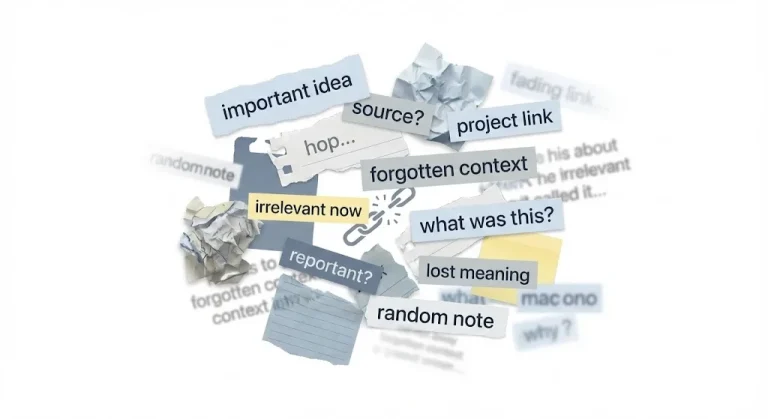



Digital clutter rarely announces itself.
There is no clear moment when it begins, no obvious sign that something is wrong.
It builds quietly, one saved link at a time, until the weight becomes noticeable—
not on the screen, but in the mind.
At first, saving information feels productive.
You collect articles, resources, references, and tools.
Each saved link feels like a small investment in the future.
But over time, the collection grows faster than your ability to use it.
What starts as preparation slowly turns into burden.
The Nature of Digital Clutter
Digital clutter is not the same as mess.
A messy desk is visible.
Cluttered information is not.
It lives in bookmarks, note-taking apps, saved messages, and open tabs.
Individually, each item seems harmless.
Together, they create an environment where attention is constantly divided.
The problem is not the quantity of information,
but the lack of structure that allows it to remain useful.
Why We Rarely Notice the Cost
Unlike physical clutter, digital clutter doesn’t slow you down immediately.
You can keep working.
You can keep saving.
Nothing breaks.
The cost shows up indirectly:
- In the extra seconds spent searching
- In the hesitation before opening saved links
- In the habit of re-searching instead of retrieving
- In the mental effort required to decide what matters
These costs are small, but persistent.
And because they are familiar, they are often ignored.
When Accumulation Replaces Understanding
Most people save information with good intentions.
They save to learn, to remember, to use later.
But saving does not guarantee understanding.
Over time, accumulation becomes a substitute for engagement.
Instead of working with information, we collect it.
Instead of building clarity, we build archives.
This creates a subtle imbalance:
the more we save, the less confident we feel navigating what we already have.
The Impact on Focus and Decision-Making
Digital clutter competes for attention even when it is not actively used.
Knowing that information is scattered creates low-level cognitive noise.
When everything feels potentially important, nothing feels clearly relevant.
Decisions take longer.
Focus becomes fragile.
This is why people keep tabs open “just in case.”
Not because they need them immediately,
but because closing them feels like losing control.
Clutter turns information into something you manage,
instead of something that supports you.

Why Traditional Organization Fails Over Time
Folders, lists, and basic bookmarks offer short-term relief.
They impose order at the beginning.
But as volume increases, these structures struggle.
Folders become too broad or too specific.
Titles lose meaning.
Search depends on memory that fades.
Eventually, the system demands more effort than it returns.
At that point, organization stops feeling helpful
and starts feeling like maintenance.
Read more: LinkMark Across All Devices
Reconsidering the Real Problem
It’s easy to frame digital clutter as a personal issue.
A matter of discipline or habits.
But the deeper problem lies in how tools define success.
If saving is the end goal, clutter is inevitable.
The real goal is not storage.
It is usability.
Information only earns its place when it can be returned to,
understood, and applied with minimal effort.
Where LinkMark Changes the Equation
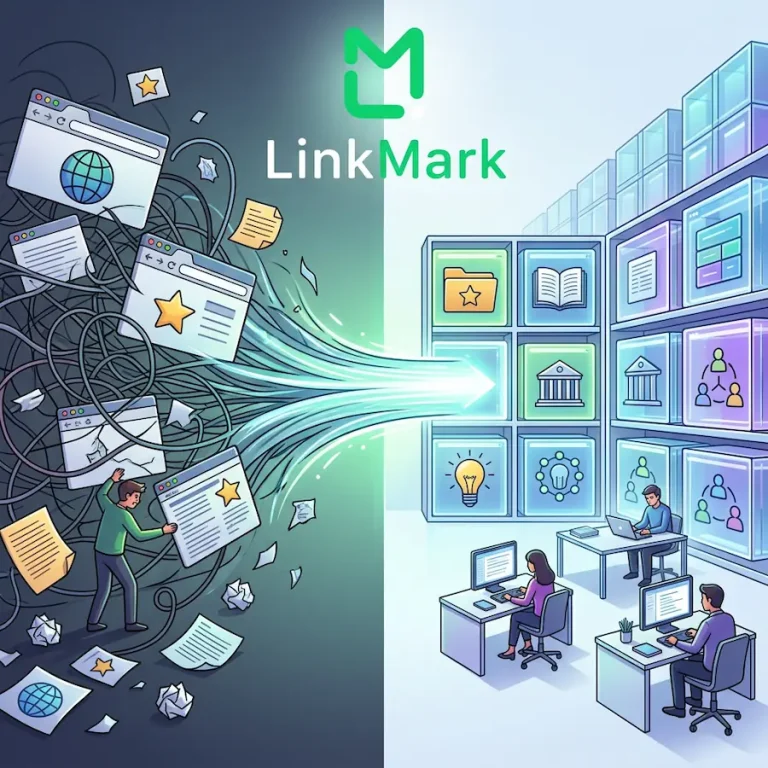
LinkMark approaches digital clutter from a different angle.
Instead of focusing on how much you save,
it focuses on how easily you can return.
Links are treated as knowledge units, not isolated pages.
Context is preserved through structure.
Organization exists to reduce cognitive load,
not to create perfect archives.
The system is designed to age well—
to remain useful as time passes and memory fades.
Reducing Clutter by Reducing Mental Load
The most meaningful reduction in clutter happens internally.
When retrieval becomes reliable,
the need to over-save disappears.
Users stop hoarding “just in case.”
They save with intention.
They trust their system.
As confidence increases, volume naturally decreases.
Clutter fades not through cleanup,
but through better design.
From Maintenance to Support
A good system does not demand constant attention.
It works quietly in the background.
With a structure that prioritizes clarity,
saved information becomes supportive rather than demanding.
Instead of managing clutter,
you work with information that is ready when you need it.
The Long-Term Effect
Over time, the impact becomes clear.
Less friction.
Less searching.
Fewer open tabs.
Focus improves because decisions are simpler.
Productivity improves because energy is spent using information,
not recovering it.
Digital space becomes lighter—not emptier, but clearer.
Conclusion
The cost of digital clutter is rarely obvious,
but it is always present.
It shows up in attention, focus, and mental energy.
Reducing that cost does not require saving less information.
It requires saving differently.
By shifting the focus from accumulation to clarity,
LinkMark reframes how digital information supports thinking.
When clutter no longer competes for attention,
information returns to its original purpose:
helping you move forward.