


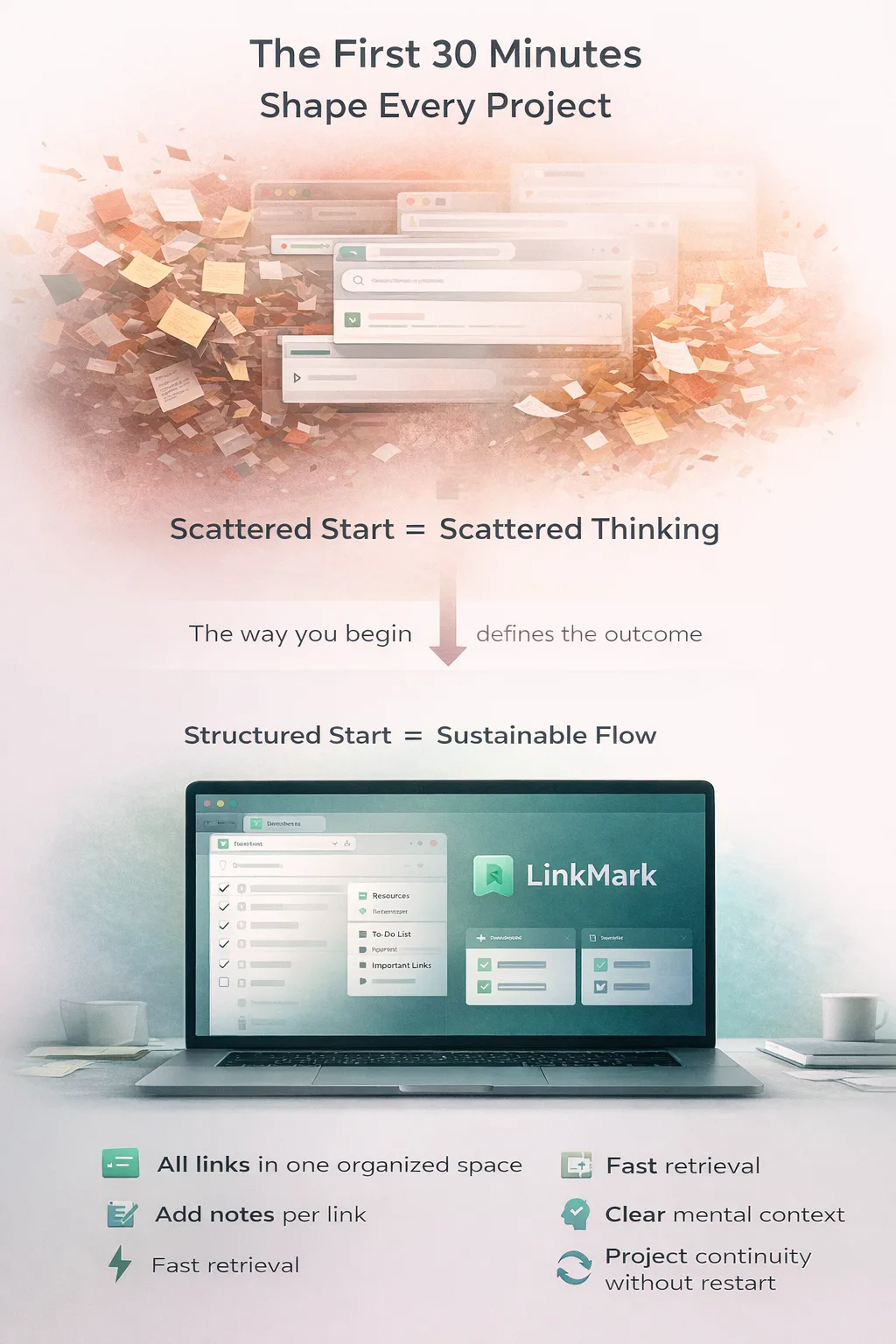
The first thirty minutes of any new project often determine everything that follows. Not the strategy, not the final execution, and not even the idea itself. It’s the beginning that quietly shapes the tone. And for most people, that beginning follows a familiar pattern: open the browser, start searching, open multiple tabs, save a few links, bookmark a few more, and promise yourself you’ll organize everything later. What feels like productive movement is often just scattered activity without direction.
Research itself is not the problem. Exploration is necessary, and gathering information is part of thinking. The real issue appears in how that information is handled during the early phase. When links are spread across open tabs, browser bookmarks, notes, and messages, the project doesn’t begin with clarity. It begins with fragmentation. And that fragmentation, even when it seems minor, influences every decision that follows.
Why the Beginning Defines the Outcome
Starting a project is more than collecting references. It is about orientation. In the first stage, you are defining scope, identifying direction, and quietly deciding what matters most. If that starting point is chaotic, your thinking becomes reactive. You respond to whatever appears in front of you rather than shaping the structure intentionally. A scattered beginning leads to hesitation, while a structured beginning creates momentum.
Many people rely on the “open tab” method. Ten or fifteen browser tabs stay open as placeholders for potential insight. Each tab represents something useful, something promising. But tabs are temporary by nature. They do not preserve structure or create continuity. Once they close or get buried, the foundation disappears, and the project must restart. This repeated restart consumes more mental energy than we often notice.
Introducing Structure at the Right Moment
This is where LinkMark changes the equation. Instead of allowing the first stage of a project to unfold across scattered tools, LinkMark introduces structure exactly when it matters most. Every saved link enters a coherent environment from the start. You are no longer collecting in isolation; you are constructing within a system. The difference is subtle but powerful. Research begins to feel intentional rather than reactive.
When starting inside LinkMark, links are not floating pieces of information. They exist within a space designed for continuity. Each resource becomes part of a growing framework that supports your thinking. Instead of juggling tabs and switching between apps, you build a structured base that remains intact beyond the first session. This shift reduces unnecessary friction and allows your attention to remain focused on shaping the project itself.
Read more: How to Use LinkMark to Organize Your Links Without Effort
From Startup Chaos to Sustainable Flow
The real impact of this approach becomes clear when you return to the project later. Everything is still there, organized and recognizable. There is no need to reconstruct context or reopen old searches. The work resumes naturally because the structure preserves the orientation you created at the beginning. Momentum continues instead of resetting.
This continuity transforms the emotional experience of starting projects. Instead of feeling slightly overwhelmed by scattered inputs, you feel prepared. Instead of questioning where something was saved, you trust the system. That trust reduces hesitation and builds confidence. And when confidence grows, creativity becomes easier and decisions feel more grounded.
Why Structured Beginnings Lead to Better Results
Projects rarely exist in isolation. They build on previous work, connect to future goals, and contribute to larger outcomes. When every project begins inside a structured environment, your workflow becomes more stable over time. You are not reinventing your starting process again and again. You are refining it.
LinkMark does more than organize links; it standardizes the way projects begin. It ensures that the earliest phase is not defined by scattered searching but by deliberate setup. That deliberate setup influences everything that follows. Execution becomes clearer. Direction becomes sharper. Decisions become faster.
The way you start shapes how you finish. Without structure, beginnings feel chaotic and progress becomes fragile. With structure in place from the first step, momentum builds naturally. LinkMark transforms the opening phase from a rush of disconnected activity into a stable launch point. And when the foundation is clear, every project moves forward with greater purpose and less friction.